
How Home Daycare Providers Can Compete With Bigger Centers Without Looking Bigger
Jul 27, 2026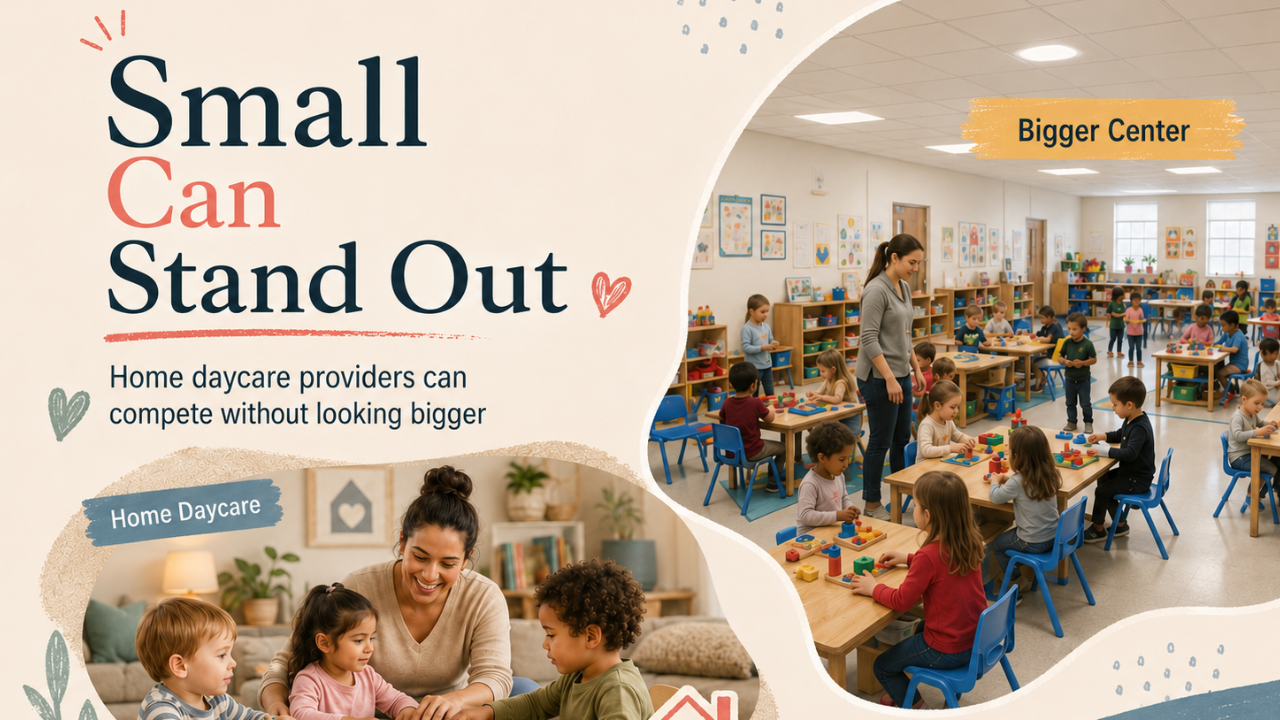
Many home daycare providers feel like they are competing against big childcare centers with bright classrooms, websites, big signs, staff photos, polished social media, and larger marketing budgets.
And because of that, they sometimes think they need to look bigger to be taken seriously.
But here is the truth:
Home daycare providers do not need to look like a center to compete with one.
They need to clearly show why a smaller, home-based childcare program can be the better fit for the right family.
Your strength is not that you are big.
Your strength is that you are personal.
The Direct Answer
Home daycare providers can compete with bigger childcare centers by marketing what makes home daycare different: small group care, one consistent caregiver, a warm home-like environment, closer communication, flexible routines, and personal connection with families.
Instead of trying to look like a large center, home daycare providers should build trust online by showing their space, daily rhythm, values, parent reviews, activities, and clear openings.
Stop Trying to Look Bigger
One of the biggest mistakes home daycare providers make is trying to copy childcare centers.
They compare their home to a building.
They compare their photos to professional center tours.
They compare their small group to multiple classrooms.
They compare their simple setup to a large playground.
But parents are not always looking for the biggest option.
Many parents are looking for the right option.
Some families want a smaller environment.
Some want one consistent caregiver.
Some want their child to feel at home.
Some want fewer transitions.
Some want closer communication.
Some want a program that feels warm, calm, and personal.
That is where home daycare providers can stand out.
Your Small Size Is a Selling Point
A home daycare is not “less than” a center.
It is different.
Your marketing should explain that difference clearly.
Instead of hiding the fact that you are small, show why small can be valuable.
You can talk about:
Small group connection
More personal attention
Mixed-age learning
A home-like daily rhythm
Consistent caregiver relationship
Stronger communication with parents
A calmer transition for young children
Sibling-like friendships
Flexible learning through play
A cozy environment
Parents may not automatically understand these benefits. You need to name them.
Your small group is not a weakness.
It is the whole lantern. 🏮
Show Parents What Your Day Feels Like
Parents are not only choosing care.
They are trying to imagine their child’s day.
Your content should help them picture it.
Post about:
Morning arrival
Breakfast or snack time
Circle time
Outdoor play
Story time
Sensory play
Nap routine
Art activities
Music and movement
Free play
Quiet moments
Pickup communication
A big center may show polished classrooms.
You can show warmth, rhythm, and relationship.
A parent should be able to look at your page and think:
“I can picture my child feeling safe there.”
That is what builds trust.
Use Your Personal Story
Home daycare providers have something many centers struggle to show: a real personal face behind the program.
Your story matters.
Parents want to know:
Who are you?
Why did you open your home daycare?
What do you believe children need?
What kind of environment do you create?
What type of family is the best fit for your program?
What makes your care different?
You do not need a dramatic founder story.
You need a clear and honest one.
For example:
“I opened my home daycare because I wanted children to have a warm, steady place where they could learn, play, rest, and feel cared for in a smaller group setting.”
That kind of message helps parents feel connected before they ever message you.
Build Trust With Simple Proof
Bigger centers may have more marketing, but trust still wins.
Home daycare providers can build trust through simple proof.
Use:
Parent reviews
Photos of your play space
Daily routine posts
Activity photos
Short videos of your setup
Testimonials
Clear policies
Program values
Your experience
Your training
Your communication style
You do not need to post children’s faces if you are not comfortable.
You can show:
Hands doing activities
Toy setups
Books
Art projects
Outdoor spaces
Meal setups
Learning invitations
Your reading corner
Your cubby area
Your backyard
Trust does not require fancy content.
It requires clear content.
Be Specific About Your Openings
Do not just post:
“Spots available.”
That is too vague.
Home daycare providers need to market the exact opening.
Say:
“I have one full-time opening for a child between 18 months and 3 years old starting in September.”
Or:
“I have one preschool-age opening available for a family looking for a small, home-based program with outdoor play, story time, simple learning activities, and a calm daily routine.”
This helps the right parent recognize the opportunity.
You are not trying to attract everyone.
You are trying to attract the right family.
Talk About What Parents Actually Want
Parents looking at home daycare may care about:
Safety
Warmth
Stability
Communication
Trust
Routine
Cleanliness
Experience
Small group care
Location
Hours
Fit
Your marketing should answer those concerns before parents ask.
Instead of only posting cute activities, explain the value behind them.
Example:
Instead of saying:
“Today we painted.”
Say:
“Today’s painting activity helped the children practice fine motor skills, color recognition, creativity, and patience while working in a small group.”
That shows parents that play is learning.
You Do Not Need to Be Everywhere
Many home daycare providers feel overwhelmed by marketing.
They think they need to be on Instagram, Facebook, TikTok, Google, YouTube, Pinterest, and everywhere else under the moon.
You do not.
Start simple.
A strong home daycare online presence can include:
A clear Facebook page
A simple Google Business Profile if appropriate
Recent photos
Parent reviews
A short introduction post
Clear opening posts
A weekly activity post
A simple way to contact you
That is enough to begin building trust.
Consistency matters more than chaos.
What to Post Each Week
Here is a simple weekly posting rhythm for home daycare providers:
One post showing an activity
One post explaining your routine or values
One post building parent trust
One post about your opening or waitlist
That gives parents a fuller picture of your program.
Not just “I have space.”
But:
“This is what care feels like here.”
Final Thoughts
Home daycare providers do not need to look bigger to compete with bigger centers.
They need to look clear, warm, trustworthy, and confident.
Your home daycare may offer exactly what some families are searching for: a smaller group, a consistent caregiver, a cozy environment, personal communication, and a place where their child can feel safe and known.
But parents need to see that value before they reach out.
So do not hide what makes your program small.
Market it.
Show the rhythm.
Share the trust.
Explain the care.
Be clear about your openings.
And remember: bigger is not always better.
Sometimes the right family is looking for something smaller, warmer, and more personal.
They just need to find you first.
Want help knowing what to post so local families can see, trust, and inquire about your home daycare?
Join me inside the Childcare Business Growth Hub, where I share simple childcare marketing prompts, content ideas, and visibility strategies to help providers show up with more clarity and confidence.
Cheering you on,
Christina
Find out how we can help your center grow by clicking here