What Do Parents Look for Online Before Choosing a Childcare Program?
Jul 06, 2026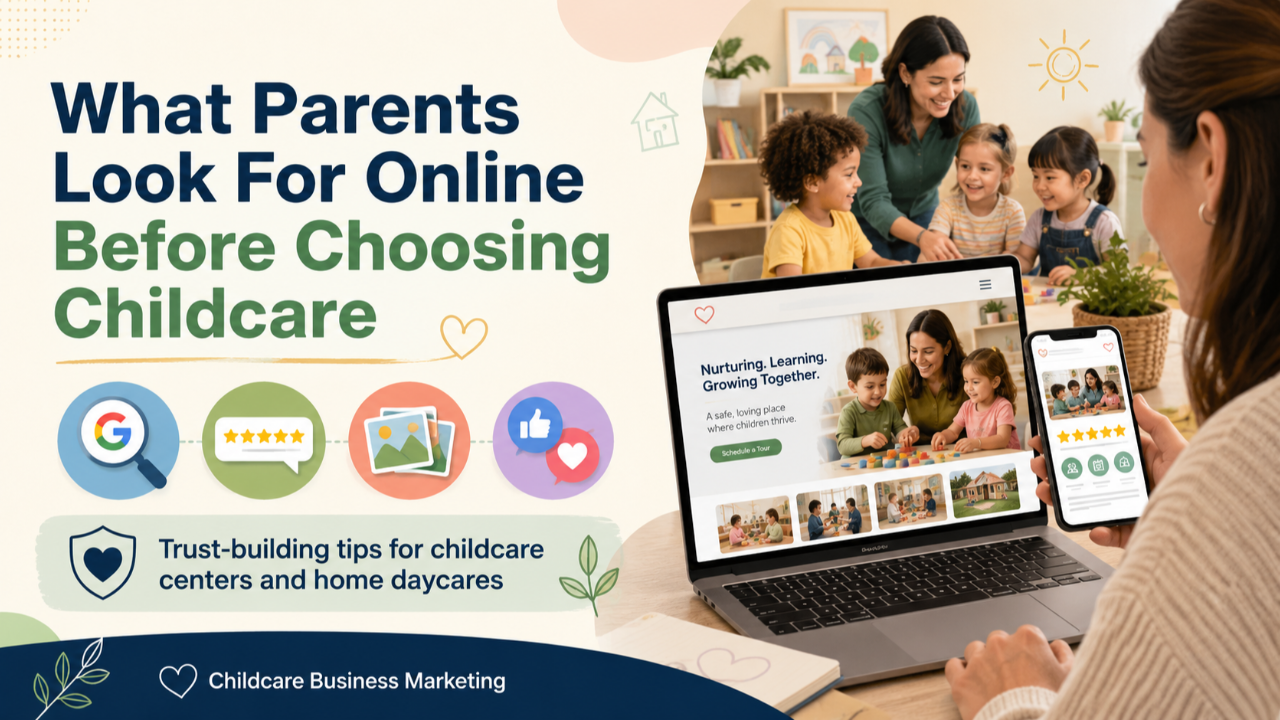
Before a parent books a tour, sends a message, or fills out your childcare inquiry form, they usually do one thing first.
They look you up online.
They may check your website, Google Business Profile, Facebook page, Instagram account, reviews, photos, and anything else they can find. They are not just looking for your hours or your tuition. They are trying to answer one very important question:
Can I trust this childcare program with my child?
The truth is, parents do not choose a childcare program based on one cute post or one “now enrolling” graphic.
They choose based on trust.
And trust is built through what they see, read, and feel before they ever speak to you.
The Short Answer
Parents look for signs that your childcare program is safe, warm, professional, active, and trusted by other families.
They want to see real photos, clear information, parent reviews, staff connection, classroom activities, communication style, and an easy way to take the next step. Your online presence should help them feel confident enough to book a visit.
If your online presence is unclear, outdated, empty, or confusing, parents may move on before you ever get the chance to talk to them.
Parents Are Researching Before They Reach Out
Many childcare owners think the parent journey begins when someone messages them.
But it usually starts much earlier.
A parent may see your name in a Facebook group. They may hear about you from another parent. They may drive past your building. They may search “daycare near me” or “childcare in [your city].”
Then they start checking.
They want to know:
Is this program still active?
Do children look happy here?
Do the classrooms look clean and welcoming?
Do other parents trust this place?
Can I picture my child here?
Does this program feel organized?
Do I know what to do next?
This is why your marketing cannot only be about posting more often. It needs to help parents feel more confident.
1. Parents Look for Real Photos and Videos
Parents want to see the real environment.
They want to see your classrooms, play areas, learning materials, outdoor space, meal setup, entrance, and daily activities.
This does not mean you need perfect professional photos. In fact, overly polished content can sometimes feel less personal. Parents want to see what your childcare program actually feels like.
Strong content includes:
Photos of children engaged in activities
Classroom setup photos
Outdoor play moments
Art, sensory, music, and movement activities
Teacher-child interactions
Walkthrough videos
Founder or director videos
Daily routine snapshots
When parents can visually understand your program, it becomes easier for them to imagine their child there.
2. Parents Look for Reviews and Testimonials
Parent reviews are one of the strongest trust signals your childcare program can have.
A parent can read all your captions and website copy, but when another parent says, “My child is happy here,” that carries weight.
Reviews help answer questions like:
Do families like this program?
Do children adjust well?
Is the staff kind?
Do parents feel informed?
Is the center reliable?
Do families stay long-term?
Your reviews should not sit quietly in one corner of the internet. You can use them in your social media posts, website sections, ad creatives, email follow-ups, and tour materials.
A good review can become a post.
A parent testimonial can become a reel.
A video review can become an ad.
A simple sentence from a happy parent can become social proof.
Parents need proof before they take action.
3. Parents Look for Clear Information
Confused parents do not usually chase you for answers.
They move on.
Your online presence should make the basics easy to find.
Parents want to know:
What ages do you serve?
Where are you located?
Are you licensed?
What makes your program different?
Do you have openings?
How can they book a tour?
What is your teaching style?
What does a typical day look like?
Do you offer infant care, toddler care, preschool, pre-K, or after-school care?
You do not need to put every single detail online, but you do need enough information to help parents understand whether your program may be a good fit.
A vague “now enrolling” post is not enough.
Instead of only saying:
“Now enrolling. Call today.”
Try saying:
“We currently have limited toddler openings for families looking for a warm, play-based childcare program in [city]. Children enjoy outdoor play, hands-on learning, caring educators, and a predictable daily routine. Message us to book a visit.”
Specific information makes your marketing stronger.
4. Parents Look for Safety and Stability
Parents are not only looking for cute activities.
They are quietly asking themselves:
Will my child be safe here?
Will the staff care about my child?
Will someone communicate with me?
Will this place feel stable?
Will my child be comforted if they cry?
Will this program support their growth?
Your content should gently answer these questions.
You can show this through:
Staff introductions
Daily routines
Clean and organized spaces
Arrival and pickup information
Communication practices
Nap and meal routines
Outdoor safety routines
Teacher experience
Licensing information
Parent updates
Photos of calm, engaged children
You do not need to sound corporate. You need to sound clear, caring, and steady.
5. Parents Look for Your Staff and Your Story
Childcare is personal.
Parents are not just choosing a building. They are choosing people.
That is why founder stories, director videos, staff spotlights, and behind-the-scenes posts matter.
A simple founder video can answer:
Why did you open this program?
What do you believe children need?
What makes your childcare different?
What kind of families do you serve best?
What do you want parents to feel when they walk in?
A staff spotlight can answer:
Who will care for my child?
What experience do they have?
Do they seem warm and approachable?
Why do they love working with children?
These pieces of content help parents feel connected before the tour.
6. Parents Look for Activity and Consistency
An inactive page can make parents wonder if your program is still open, organized, or accepting families.
This does not mean you need to post every day.
But your online presence should show signs of life.
A parent should be able to see that your program is active, children are learning, staff are engaged, and the center is communicating.
Helpful weekly content can include:
One activity post
One parent trust post
One staff or classroom post
One opening or tour post
One review or testimonial post
Consistency helps parents feel reassured. It shows that your program is not just caring for children behind closed doors, but also communicating clearly with families.
7. Parents Look for an Easy Next Step
One of the biggest mistakes childcare programs make is creating interest but not giving parents a clear next step.
A parent should never have to guess what to do next.
Your posts, website, and Google Business Profile should make it easy to:
Book a tour
Send a message
Call the center
Fill out an inquiry form
Ask about openings
Join a waitlist
Every piece of marketing should guide the parent somewhere.
Instead of ending a post with:
“Contact us for more information.”
Try:
“Message us today to book a visit and see if our toddler program is the right fit for your family.”
Or:
“Looking for care this fall? Send us a message with your child’s age and ideal start date.”
The clearer the next step, the easier it is for a parent to take action.
What Childcare Centers Should Have Online
Every childcare center should have a simple trust-building system online.
You do not need to be fancy. You need to be clear.
At minimum, your childcare program should have:
A complete Google Business Profile
Recent photos
Parent reviews
A clear website or landing page
Updated social media pages
A simple tour booking process
Posts that show real classroom life
Content that explains your unique difference
Staff or founder introduction content
Clear calls to action
These pieces work together.
Your Google profile helps parents find you.
Your reviews help parents trust you.
Your photos help parents picture their child there.
Your website gives them more information.
Your social media shows your program is active.
Your follow-up helps turn interest into a visit.
This is not just marketing.
This is your enrollment pathway.
What Home Daycare Providers Should Have Online
Home daycare providers do not need to copy big childcare centers.
Your strength is often your personal connection, smaller group size, home environment, and close communication with families.
Parents may want to see:
Your play space
Your daily rhythm
Your outdoor setup
Your meals or snack routines
Your learning activities
Your personality
Your values
Parent reviews
Clear opening information
Your location area
How to contact you
You do not need to show everything. But you do need enough to help a local parent feel comfortable reaching out.
For a home daycare, trust often comes from simple, real content.
A photo of your reading corner.
A sensory bin setup.
A short post explaining your daily routine.
A parent review.
A video introducing yourself.
A clear post about who your opening is for.
That is powerful.
Why “Now Enrolling” Is Not Enough
There is nothing wrong with saying you are enrolling.
The problem is when that is the only message parents see.
“Now enrolling” tells parents you have space.
It does not tell them why they should choose you.
It does not show them your environment.
It does not explain your program.
It does not build trust.
It does not answer their quiet concerns.
Instead of only promoting the opening, promote the reason the opening is worth asking about.
For example:
Instead of:
“Now enrolling preschoolers.”
Say:
“Our preschool program helps children build confidence, independence, early literacy skills, friendships, and school readiness through play-based learning. We currently have limited openings for families looking for care in [city]. Message us to book a visit.”
That gives parents a reason to care.
The Real Goal of Childcare Marketing
The goal of childcare marketing is not just to get more likes.
It is not just to post more.
It is not just to look busy online.
The real goal is to help the right local families see you, trust you, inquire, and book a visit.
When your online presence answers the questions parents already have, your marketing becomes much more effective.
You are no longer just posting to fill space.
You are building confidence.
You are creating connection.
You are helping parents move from unsure to interested.
And in childcare, trust comes before the tour.
FAQ: What Parents Look for Before Choosing a Childcare Program
What do parents look for when choosing a daycare?
Parents look for safety, warmth, cleanliness, caring staff, communication, reviews, real photos, clear information, and a program that feels like the right fit for their child and family.
Why are parent reviews important for childcare marketing?
Parent reviews help build trust. They show that real families have had a positive experience with your childcare program. Reviews can help new parents feel more confident before booking a tour.
What should a childcare center post online?
A childcare center should post classroom activities, staff introductions, parent reviews, learning moments, outdoor play, program information, available openings, tour invitations, and behind-the-scenes content that helps parents understand the program.
Do childcare centers need a website?
A website is very helpful because it gives parents one clear place to learn about your program, ages served, location, philosophy, openings, and tour process. Even a simple website or landing page is better than making parents search for scattered information.
How can a home daycare build trust online?
A home daycare can build trust by sharing real photos, daily routines, learning activities, parent reviews, clear opening details, and a simple introduction from the provider. Parents want to know who you are and what their child’s day will feel like.
Why are parents viewing my posts but not booking a tour?
Parents may be interested but not ready to act. They may need more proof, clearer information, stronger reviews, better follow-up, or a more direct call to action. Interest does not always turn into enrollment without a clear next step.
What is the best call to action for childcare marketing?
A strong call to action tells parents exactly what to do next. Examples include “Message us to book a visit,” “Send us your child’s age and ideal start date,” or “Call today to ask about our current openings.”
Final Thoughts
Parents are not just looking for a childcare spot.
They are looking for peace of mind.
Before they contact you, they want to feel that your program is safe, caring, active, professional, and trusted by other families.
Your online presence should help them feel that.
When your photos, reviews, website, Google profile, social media, and follow-up all work together, you make it easier for the right families to say:
“This feels like a place I want to visit.”
And that is where enrollment conversations begin.
Want help knowing what to post so local families can see you, trust you, and inquire?
Cheering you on,
Christina
Find out how we can help your center grow by clicking here